The Gluteus is comprise of three smaller muscles, the Gluteus Maximus, the Gluteus Medius and the Gluteus Minimus. The gluteus is our rear end, and is the biggest muscle group on the body.
The gluteus is mainly responsible for allowing your legs to rotate at the hip, turing the thighbones outward. This is called an "external rotator." Because there are more muscles that act as "inward rotators" - muscles that pull the thighs inward - than external rotators, the lack of proper exercise will cause the outward rotators to weaken, in turn causing the thighs to point inwards. This results in several problems, including pigeon-toes, and high arches in feet. It can also cause undo strain on the knees, and tightening of the hamstrings.
Showing posts with label Muscle of our body. Show all posts
Showing posts with label Muscle of our body. Show all posts
Sunday, April 26, 2009

Hamstrings Muscle
Hamstrings consist of three major muscles, the Biceps Femoris, Semitendinosus and the Semimembranosus, and are located in the rear thigh.
 Hamstrings control the bending of the knees and have much to do with correct posture. With weak hamstrings, one may have a tenancy to lock one's knees, bringing the body over it's center line, and causing more extreme curves in the spine. Hamstrings also help us keep balanced as we walk.
 Hamstrings control the bending of the knees and have much to do with correct posture. With weak hamstrings, one may have a tenancy to lock one's knees, bringing the body over it's center line, and causing more extreme curves in the spine. Hamstrings also help us keep balanced as we walk.
Abdomen Muscle
The abdominal muscles are commonly known as stomach muscles and consist mainly of two large muscle groups, Obliques and Rectus Abdominis. The Rectus Abdominis are located down the center of the abdomen, while obliques are to the sides.

 The abdomen is one of the most important muscle groups to exercise regularly because it does much of the work in keeping your lower back aligned correctly.

 The abdomen is one of the most important muscle groups to exercise regularly because it does much of the work in keeping your lower back aligned correctly.
Back Muscle
The Upper Back consists of several different muscle groups, including the trapezius and rhomboids. The trapezius (known as "traps") is a large muscle group extending from the upper back down the middle of the back. Rhomboids is a large muscle group in the middle of the back. The Latissimus Dorsi (known also as "lats") stretch from the upper arm ot the lower back.

 The upper back muscles, including the rhomboids and trapezius, hand much of the burden of lifting, and do much of the work rotating the scapula (shoulder blade). These muscles are normally one of the strongest muscles on the body because they are required for so much of our daily work. However, since rhomboids retract the shoulders, and elevate the shoulder blades, weak rhomboids can result in a decline of proper posture. Weakness in any of the major back muscles can result in bad posture.

 The upper back muscles, including the rhomboids and trapezius, hand much of the burden of lifting, and do much of the work rotating the scapula (shoulder blade). These muscles are normally one of the strongest muscles on the body because they are required for so much of our daily work. However, since rhomboids retract the shoulders, and elevate the shoulder blades, weak rhomboids can result in a decline of proper posture. Weakness in any of the major back muscles can result in bad posture.
Calves Muscle
Calves are a large muscle group in the lower leg, including the Gastrocenemius and the Soleus.

 The calves are important for a number of basic physical requirements, including balance, walking, running and most lower-body oriented activity. Weakened calves can result in over-compensation by other muscle groups.

 The calves are important for a number of basic physical requirements, including balance, walking, running and most lower-body oriented activity. Weakened calves can result in over-compensation by other muscle groups.
Biceps Muscle
Biceps are a group of two major muscles that extend from the elbow to the shoulder.

 The major function of biceps is to retract the arm. Therefore, biceps do a lot of the work of carrying objects when the arm is at an angle.

 The major function of biceps is to retract the arm. Therefore, biceps do a lot of the work of carrying objects when the arm is at an angle.
Chest Muscle
The Chest consists of four major muscle groups: the Pectoralis Major (Pectorials or Pecs), Steral, Pectoralis Major, Clavicular, Pectoralis Minor and Serratus Anterior.
 Your chest muscles work in tandem with many of your other muscles to provide lifting ability. They also are responsible for some shoulder rotation as well.
 Your chest muscles work in tandem with many of your other muscles to provide lifting ability. They also are responsible for some shoulder rotation as well.
Quadriceps Muscle
Quadriceps are a large muscle group which make up the front thigh, and are also called "quads". The major muscles making up the quadriceps are the rectus femoris, vastus lateralis, vastus intermedius, and vastus medialis.

 The primary role of the quadriceps is to extend and straighten the leg outwards. Weakened quadriceps can have negative effects on leg posture and the correct movement and positioning of the knee.

 The primary role of the quadriceps is to extend and straighten the leg outwards. Weakened quadriceps can have negative effects on leg posture and the correct movement and positioning of the knee.
Forearms Muscle
Forearms consist of a number of muscles including the brachioradialis and six wrist flexors. The forearm is situated between the wrist and the elbow.
 Forearm muscles do much of the work in gripping and working with one's hands. Limited strength in the forearms can result in fatigue while doing many of the tasks required by hands like cooking, yard work and holding power tools.
 Forearm muscles do much of the work in gripping and working with one's hands. Limited strength in the forearms can result in fatigue while doing many of the tasks required by hands like cooking, yard work and holding power tools.
Triceps Muscles
Triceps are a group of three major muscles in the rear of the arm. They are typically twice as large as the biceps.

 Triceps are responsible for shoulder and elbow rotation. Since triceps are significantly larger than the biceps, they play an important role in lifting and lowering any amount of weight.

 Triceps are responsible for shoulder and elbow rotation. Since triceps are significantly larger than the biceps, they play an important role in lifting and lowering any amount of weight.
Shoulder Muscles
The shoulders are made up of several different muscle groups, including the Anterior Deltoid, Lateral Deltoid, Posterior Deltoid and Supraspinatus. The shoulder is the area between the upper arm, neck and back muscle groups


 Your chest muscles work in tandem with many of your other muscles to provide lifting ability. Chest muscles also are responsible for shoulder and upper arm rotation as well.


 Your chest muscles work in tandem with many of your other muscles to provide lifting ability. Chest muscles also are responsible for shoulder and upper arm rotation as well.
Neck Muscles
There are two main neck muscle groups, the sternocleidomastoid and splenius. The neck muscles link the shoulders and upper back to the head.


Neck muscles are responsible for neck rotation and movement. They also hold the weight of the head when tilted to the side and are used in connection with the arms for lifting.
Anatomy
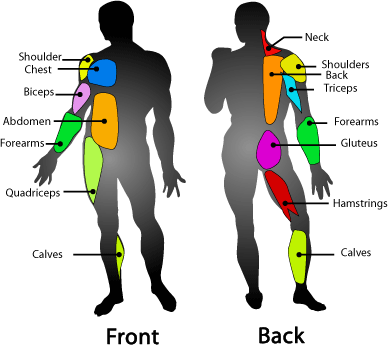
We have collected a number of body building / weight lifting exercises for all of the major muscle groups. Some require only a barbell while others require a particular machine.
Subscribe to:
Posts (Atom)


